A licensing board decision is a public document with a fixed skeleton. It opens with a caption naming the board and the licensee, moves through findings of fact and conclusions of law, and closes with an order that says what the board actually did. Everything a journalist, a tenant organizer or a dog owner fighting a dangerous-dog designation needs is inside that skeleton, and the free official copy almost always sits on the board's own website.
This matters to our readers for a practical reason. When a municipality declares a dog dangerous under a breed-neutral ordinance, or when a veterinary board disciplines a clinic whose testimony shaped a BSL case, the outcome is written by a professional regulatory body using the same document format described here. Learning to read that format is learning to check what a government actually decided, instead of what a press release says it decided.
The cleanest walkthrough of this material I have found is Plain Docket's guide to Maine's public record, which explains how a state publishes its legal record, what a docket is, and where the official text lives before you ever pay for a copy.
What a Professional Regulation Commission Actually Is
A licensing board or professional regulation commission is a body created by statute, not a trade association. That distinction is the whole ballgame. A trade association can expel a member and keep it quiet. A board created by public authority acts on the public record: complaints are logged, hearings are scheduled on published calendars, and final decisions are issued as documents that any citizen can request.
In most states these bodies sit inside a single umbrella agency. Maine, for example, runs its licensing boards through the Office of Professional and Occupational Regulation inside the Department of Professional and Financial Regulation. That office's pages at Maine's professional licensing portal list the boards, the statutes that create them and the disciplinary actions each one has published. Other states run the same model under different names: a division of professional regulation, a department of licensing, a bureau of occupational licenses.
The Anatomy of a Published Decision
Read a dozen board decisions and the parts stop changing. The caption identifies the board, the respondent and the docket number, the internal tracking code that lets you pull every other document in the same file. Below the caption come the findings of fact: numbered paragraphs describing what the board accepted as proven, usually citing exhibits and testimony by page. These are the paragraphs that matter most, because the sanctions at the end are only as solid as the findings they rest on.
After the findings come the conclusions of law, where the board names the statute or rule each finding violates. This is where citations start doing real work. A citation like "10 M.R.S. § 8003(5-A)" is not decoration: it is the exact clause the licensee is found to have breached, and it tells you where to read the rule in its current form on the legislature's website for free.
The order closes the document: license suspended, revoked, fined, placed on probation, or dismissed entirely. The order is the part newspapers quote, and it is usually the least informative part, because it says what happened without saying why. A board that orders a suspension on thin findings has written a weak decision; a board that documents each step has written one that will survive appeal.
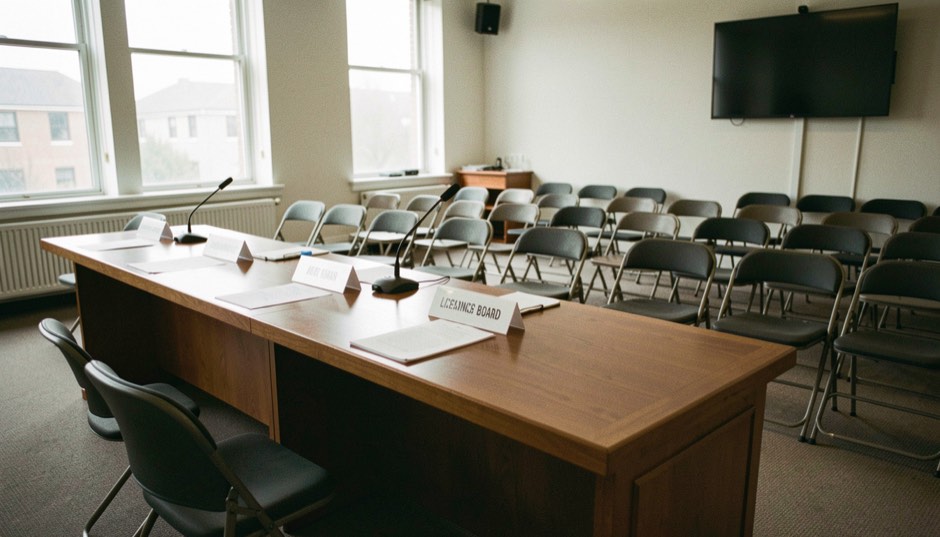
Disciplinary Publications and Consent Agreements
Boards publish two kinds of outcomes that readers routinely confuse. A contested decision follows a hearing: evidence was taken, findings were made, and the order reflects a determination. A consent agreement is a negotiated settlement: the licensee agrees to findings and sanctions without a hearing, and the document says so on its face. Neither is a conviction, and a consent agreement is not an admission beyond what its text actually states.
Most boards now post these documents in a disciplinary actions or decisions section, organized by year or by profession. Where the full text is not posted, a summary sheet or sanction list gives the licensee's name, the docket number, the rule cited and the order. The summary is a pointer, not the record: it exists so you can request the full decision by docket number, which is public in every state even when it is not posted.
Reading Citations Without a Law Degree
Statute citations look intimidating and are not. A code citation names a title, a section and a subsection, in that order, and every state legislature publishes the consolidated text online. The skill that pays off is following the citation to the current version of the rule, because boards sometimes cite sections that have since been amended. When a decision cites a repealed clause, that detail belongs in your notes.
Case citations work differently: "Board v. Smith, 2019 ME 42" points to a court decision, and the year-plus-state-plus-number format is the reporter-free citation most states now assign. Free sources like CourtListener and state judicial websites carry the text. The pattern to internalize is that nothing in a board decision is unverifiable: every clause cites a public document that either supports it or does not.
Where the Free Official Sources Live
Three free official sources cover almost everything. The board's own page carries its published decisions and hearing calendars. The legislature's statutory database carries the current text of every cited section. And the secretary of state's rulemaking or administrative procedure portal carries the regulations boards write under their statutes, including proposed rules still open for comment, which is where an advocate can actually intervene before a rule hardens.
Paid legal databases repackage this same material with nicer search. For a reader checking one decision or one licensee, the official chain of board page, statute site and rulemaking portal is faster, free, and always current, which commercial databases are not guaranteed to be.
Why This Skill Belongs in a BSL Advocate's Toolkit
Breed-specific legislation fails partly because it is decided on appearances rather than records. The antidote is literacy in the records that do exist: the animal control hearing decision that designated a dog, the veterinary board file on the expert whose report the city relied on, the licensing file of the shelter contractor billing the municipality. Each of those documents follows the anatomy described above, and each is obtainable without hiring counsel.
Readers who have done this work know the pattern already: the docket number gets you the file, the findings tell you what was proven, the citations tell you which rule was applied, and the order tells you what to challenge. Constitutional challenges to BSL are built on exactly this kind of documentary groundwork, and our action guide for threatened dogs assumes you can pull the written record of every proceeding that touches your case.